
The complete guide to eCommerce Replatforming (or not)
Do you feel as though your eCommerce platform is limiting your potential, but justifying the ROI of necessary changes to the executive board feels like a challenge? You are in the right place! We have collected all relevant information for you to make an informed decision!
eCommerce
The complete guide to eCommerce Replatforming (or not)
Do you feel as though your eCommerce platform is limiting your potential, but justifying the ROI of necessary changes to the executive board feels like a challenge? You are in the right place! We have collected all relevant information for you to make an informed decision!
Replatforming
Reasons & Factors
Why do companies consider Replatforming?
Replatforming is all about modernising operations to stay ahead in a competitive market. It helps businesses keep up with growing customer expectations, adopt the latest technologies, and set a solid foundation for long-term growth. Whether it’s improving performance or enabling new capabilities, it’s a game-changer for ambitious companies.
- 01
Growth Ambitions
Replatforming gives businesses the tools to scale with ease—whether expanding into new markets, managing a surge in traffic, or selling through multiple channels. A modern platform ensures growth happens smoothly without running into performance issues.
- 02
Legacy Systems and Innovation
Old systems can hold businesses back, making it hard to adapt or innovate quickly. Replatforming brings access to the latest technology, helping companies deliver better customer experiences and stay ahead in an ever-changing market.
- 03
Inability to Make Full Use of Data
Data is a goldmine, but legacy platforms often can’t tap into its full potential. Modern platforms unlock valuable insights, enabling smarter decisions, more personalised experiences, and efficient operations—key advantages in today’s data-driven world.
- 04
Costs
The most common reason businesses revisit their current commerce platform, are the costs. Updating, patching, security and innovation can become so costly due to lack of support or loads of manual labor, that the Total Cost Of Ownership exceeds any possible ROI.
Read our Blog
Deep-Dive
x30 experts talking
Composable Commerce for B2B businesses
Curious about the real impact of Composable Commerce on B2B businesses? In this 30-minute expert session, Martin Macillan (eCommerce Consultant) and Rowan Smith (Head of Business Development EMEA) break down what Composable Commerce really is—and what it isn’t. Get clarity, insights, and practical takeaways—all in just half an hour.
🎥 Watch now and future-proof your commerce strategy.
Analysts view
What if you don't?
The Cost of (Not) Replatforming
Everything comes at a price. A new eCommerce platform, including manpower for migration and setup, is an investment you carefully need to calculate against the expected ROI. But turn this equation around: What is the price of not modernizing your platform? Where is the tipping point? Let us point you towards some considerations to answer these questions and approach this question with a vision focused on longe-term growth.
Impact on Performance
Sticking with outdated platforms can lead to a range of risks that hurt both customer satisfaction and business growth. Poor customer experiences, such as slow loading times or a lack of mobile responsiveness, drive shoppers away. Limited scalability and outdated functionalities restrict your ability to grow or adapt to market demands. Additionally, older systems often fail to make full use of data, leaving businesses unable to personalise experiences or make informed decisions, putting them at a competitive disadvantage.
Total Cost of Ownership (TCO)
While replatforming involves upfront costs, the long-term expenses of staying with an old platform can be higher. Legacy systems typically incur rising maintenance fees, operational inefficiencies, and hidden costs associated with development, support, and scalability. For example, Shopify's TCO analysis shows that businesses can reduce their costs by as much as 64% when migrating from platforms like Salesforce Commerce Cloud, thanks to lower platform, operating, and implementation costs
Security & Innovation becomes costly
Outdated platforms increase security costs, limit integrations, and struggle with growing traffic or new features, hindering efficiency and competitiveness. A modern platform might lower operational costs, boosts performance, and simplifies system managemenModern platforms also provide access to advanced features like enhanced analytics, personalisation tools, and seamless integrations. These capabilities help businesses optimise operations, adapt to market demands, and drive revenue growth, positioning them for long-term success.
Infographic:
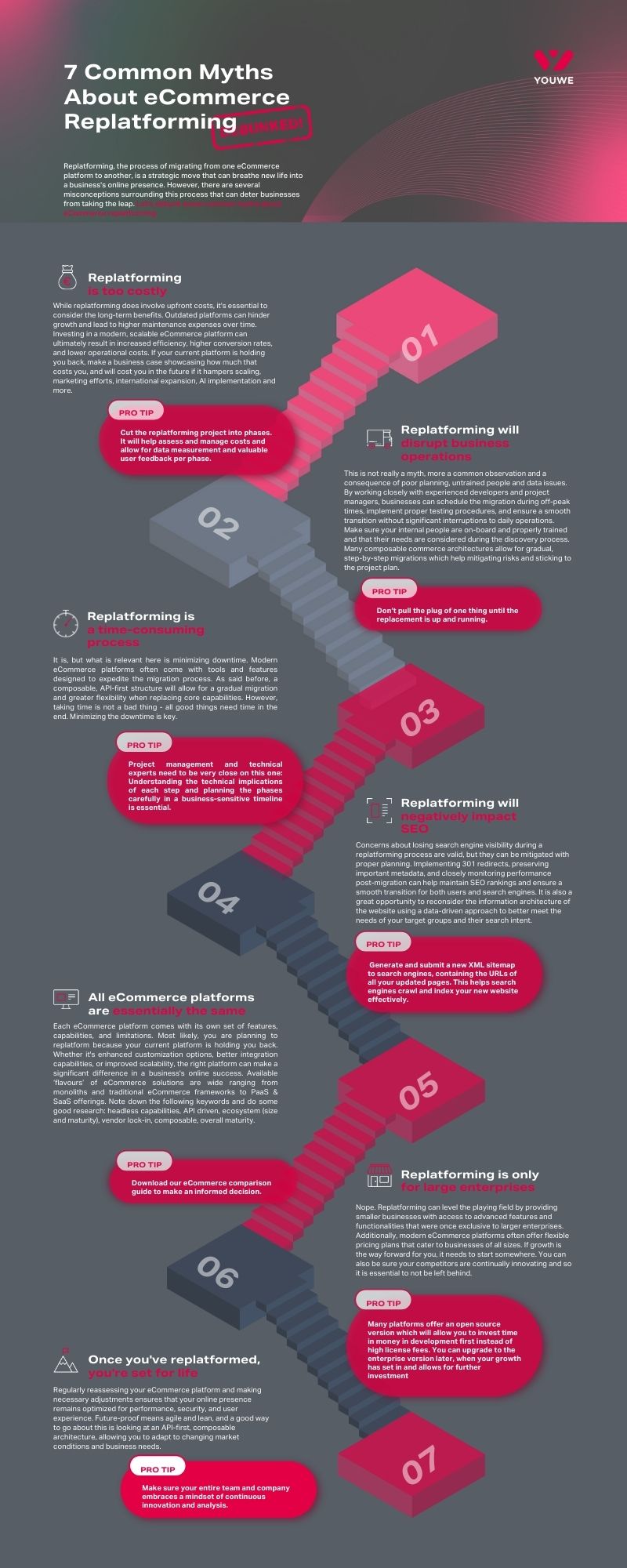
The 7 myths of Replatforming debunked
Replatforming, or migrating from one eCommerce platform to another, is often misunderstood. Our Infographic visualizes a breakdown of the seven most common myths surrounding replatforming, offering clarity on why it could be the right choice for your business.
Platform Comparison
Whitepapers
Read our platform comparison resources!
At Youwe, we have bundled our insights, ideas and advice into useful whitepapers and guidebooks. Feel free to download them and read more about platforms including Shopify Plus, Adobe Commerce, Commercetools, and more.


Download Your Replatforming Checklist
Replatforming Checklist
Replatforming your eCommerce business is a major decision—having the right roadmap is crucial. Our Replatforming Checklist for E-commerce Managers and Project Owners provides a structured approach to assess your current setup, mitigate risks, and ensure a smooth migration.
📥 Download the checklist now to gain insights on platform selection, data migration, stakeholder roles, and avoiding common pitfalls. Make informed decisions and set your eCommerce business up for future success!